Add your promotional text...

Iran Does Not Need External Regime Change—Its People Will Decide the End
Iran’s future will not be written by foreign capitals repeating the mistakes of the past. The 1953 overthrow of Mohammad Mossadegh, carried out with external backing, left a legacy of mistrust that still shapes Iranian politics. That episode hardened nationalist resentment, empowered authoritarian rule, and ultimately helped pave the way for the 1979 revolution. Further interventions, such as the clandestine support for Iraq during the Iran-Iraq War and economic sanctions, have reinforced the narrative of external meddling, galvanizing nationalistic fervour and a siege mentality. These instances have deepened distrust of outside influence and strengthened a desire for sovereignty and self-determination. Today’s Iran is different, and so is the path to change. The forces that will determine the Islamic Republic’s fate are internal, persistent, and increasingly irreversible. To understand the trajectory of Iran's transformation, we must consider how the interplay of historical legacy, succession dynamics, regional challenges, and domestic protests shapes a singular, inevitable narrative arc. This interconnected framework underscores that Iran's journey is driven by factors within its borders, setting the stage for a momentous period of change ahead.
At the center of the looming rupture is succession. Iranian Supreme Leader Ali Khamenei is aging, his public appearances are rarer, and his authority is sustained more by institutional inertia than popular consent. When he dies, the transition will not resemble a clean constitutional handoff. The Assembly of Experts may designate a successor or attempt a collective leadership. Still, absolute power will be contested among clerical hardliners, security institutions, and economic patronage networks accustomed to operating under a single arbiter. According to the Iranian Constitution (Article 107), the Assembly of Experts is tasked with selecting the new Supreme Leader; yet historical precedent from Khamenei’s own succession in 1989 revealed that behind-the-scenes bargaining among factional leaders played a decisive role. The clerics are driven by a desire to maintain their religious influence and uphold theocratic governance.
Meanwhile, the Revolutionary Guards and other security forces seek to underpin their grip on power and protect their extensive business interests. The economic elite, having thrived under existing systems of patronage, will also vie for clout to preserve their financial dominance. Recent disputes over budget allocations between these factions have highlighted the intense jockeying that occurs behind closed doors. The system was designed to suppress competition, not manage it. Removing the apex exposes fractures that have long been contained.
This succession crisis will unfold amid unprecedented regional weakness. Iran's longstanding strategy of projecting power through proxies has been battered by last year's war with Israel and by events it did not fully control. The fall of the Bashar al-Assad regime in Syria stripped Tehran of its most critical Arab ally and land bridge to the Levant. Meanwhile, the operational reach and deterrent value of Iran's proxy network, from Hezbollah to Hamas and the Houthis, have been sharply degraded. Reports from various analysts have highlighted a significant reduction in financial and military support to these groups, leading to decreased operational effectiveness. Recent expert assessments have underscored the decline in Hezbollah's influence in Lebanon and the reduced capacity of the Houthis in Yemen due to resource constraints. In contrast, other regional powers, such as Saudi Arabia and Turkey, have leveraged their alliances more effectively, benefiting from global systemic incentives and a more dynamic approach. These comparisons highlight how Iran's reliance on proxies has transformed what once appeared to be strategic depth into a strategic liability, imposing greater costs as returns diminish.
These external setbacks matter because the regime’s legitimacy has long leaned on resistance abroad to justify repression at home. As regional leverage erodes, the narrative collapses—just as domestic pressure intensifies. The spark for that pressure was the killing of Mahsa Amini in 2022, which triggered the Women, Life, Freedom movement and permanently changed the social contract. The protests were not a moment; they were a turning point. Fear no longer functions as it once did.
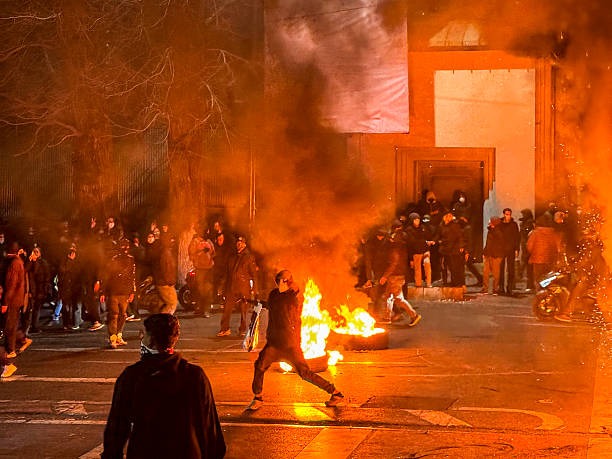
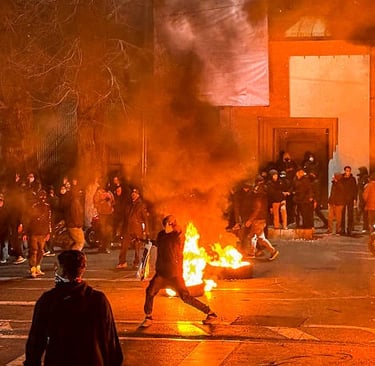
The current 2026 economic protests in Iran have been driven above all by a profound and worsening economic crisis that has eroded living standards and shaken public confidence in the Islamic Republic. A dramatic depreciation of the Iranian rial, which hit historic lows against the U.S. dollar, has fueled acute inflation—especially for food and essential goods—sapping purchasing power and squeezing households across the country. Chronic issues such as high unemployment, weak economic growth, and persistent budget deficits have been compounded by debilitating international sanctions that restrict oil revenues and access to foreign capital, while government mismanagement and subsidy reforms have exacerbated hardship. What began in late December 2025 with strikes by bazaar merchants over price spikes and currency collapse quickly spread nationwide, intertwining economic grievances with broader discontent over political corruption, inequality, and the regime’s priorities, making the protests among the most widespread and sustained in Iran’s recent history.
History shows that authoritarian systems rarely fall because outsiders topple them; they collapse when elites fracture, legitimacy evaporates, and citizens refuse to comply. Iran is approaching that convergence. The coming succession will test elite cohesion, regional losses have narrowed the regime’s room to maneuver, and a society already in motion is prepared to press its advantage.
For external actors observing Iran's transformation, the best policy may be one of cautious engagement and strategic patience. Instead of direct intervention, international stakeholders should focus on supporting regional stability and open channels of communication for when Iran transitions. A concrete step would be the establishment of humanitarian banking channels, allowing for essential goods and services to reach Iranian civilians without empowering the regime. Another viable tool could be cultural exchanges aimed at fostering mutual understanding and dismantling barriers to trust. Encouraging diplomatic dialogue, human rights advocacy, and economic partnerships, contingent on progress in domestic reforms, may offer constructive avenues for engagement without repeating past mistakes.
Iran does not need another 1953. It does not require externally imposed regime change. The end of the Islamic Republic, when it comes, will be authored by Iranians themselves, defined by generational resolve, economic reality, and a system no longer able to outlast its people.
Junaid Ahmad is the President and Chief Executive Officer of the Center for Foreign Affairs & Defense Policy (CFADP) in Washington, D.C.
This commentary is published by the Center for Foreign Affairs & Defense Policy (CFADP), an independent, nonprofit, tax-exempt research organization dedicated to the study of international affairs, security, and defense policy. CFADP’s work is nonpartisan and nonproprietary, and the organization does not advocate for specific policy outcomes. The analyses, interpretations, and conclusions presented herein are solely those of the author(s) and do not necessarily reflect the views of CFADP, its leadership, or affiliates.
© 2026 Center for Foreign Affairs & Defense Policy. All rights reserved.
Commentary by Junaid Ahmad
Published January 19, 2026
Stay Informed


COLUMBIA HEIGHTS - Post Office™
3321 GEORGIA AVE NW,
WASHINGTON, DC 20010
© 2026. All rights reserved.
Contact communications@cfadp.org
About CFADP
Research
Programs
Careers
Events
Sign up to receive expert analysis from the Center for Foreign Affairs & Defense Policy—bringing you clear insights on the world’s most pressing issues, rapid updates as events unfold, and highlights from our latest research and commentary.