
After the Sweep: Japan’s Next Chapter Under Sanae Takaichi
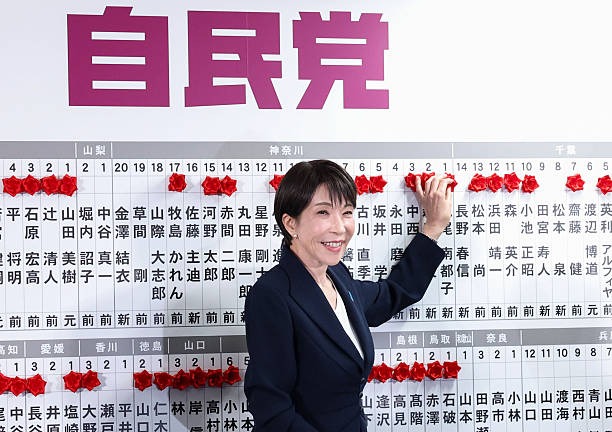
Japan's snap election has delivered something rare in modern Japanese politics: clarity. With Sanae Takaichi leading the Liberal Democratic Party to a decisive sweep, voters have not simply endorsed a government—they have handed it latitude. What comes next is less about coalition management and more about direction. The result signals a turning point for Japan's economy, its banking markets, and its tactical posture in an increasingly volatile Indo-Pacific.
Economically, the election result immediately changes expectations. Markets now see policy continuity paired with ideological conviction. Takaichi's long-standing emphasis on economic autonomy, industrial resilience, and growth-focused fiscal policy suggests Japan will lean into state-backed revitalization rather than premature austerity. This time, the scale of action is clear: the cabinet is reportedly preparing a fiscal stimulus package worth 30 trillion yen, nearly double the size of the initial Abenomics-era injection in 2013. On wages, Takaichi has already signalled support for annual increases targeting at least three percent, compared to subdued growth hovering at or below one percent for the past decade. For years, Japan has been trapped between deflationary instincts and cautious reform. This decisive mandate gives the government rare political cover to act assertively, particularly on wage growth, domestic investment, and strategic industries. Still, delivering on such an ambitious agenda will not be straightforward. Policy execution could encounter resistance from within the bureaucracy, which often favours gradual change and consensus-driven decision-making. Similarly, business leaders may hesitate to embrace mandated wage hikes, citing concerns over international competitiveness and operational costs. Past stimulus efforts have sometimes been slowed by complicated approval processes and uneven implementation at the local level. For this administration, the challenge will be translating the new political latitude into rapid, coordinated action that overcomes these structural hurdles.
The yen is the first pressure point. A strong LDP mandate reduces near-term political uncertainty, which, in isolation, supports currency stability. However, it is essential to distinguish between tactical (six-month) currency dynamics and more strategic, multi-year structural drivers. In the near term, over the next several months, stability may prevail as markets digest electoral outcomes and policy signals. Short-term trading could see the yen fluctuate in response to immediate fiscal announcements and central bank communication, including any hints from the Bank of Japan about its gradual exit from ultra-loose monetary policy.
Looking further ahead, policy choices will have stronger and more lasting effects. If the government pursues fiscal expansion, particularly through increased defense spending and industrial subsidies, and the Bank of Japan does not tighten aggressively, the yen is poised to remain structurally weak over the medium term. This long-term depreciation is no longer viewed solely as a liability. For exporters and advanced manufacturers, a softer yen supports competitiveness as supply chains are being re-regionalized and reshored. Should wage growth and domestic demand finally strengthen, the yen's multi-year weakness could shift from being a symptom of stagnation into a bridge toward sustained reflation. However, risks remain if the Bank of Japan tightens monetary policy faster than markets expect. A faster withdrawal from ultra-loose policy could trigger a sharp appreciation of the yen, increasing costs for exporters and potentially stalling momentum in both wage growth and domestic investment. Conversely, if fiscal expansion underperforms—whether because stimulus is smaller than planned, slow to implement, or diluted by bureaucratic obstacles—the positive effects on domestic demand and inflation could fall short, prolonging stagnation and limiting the intended strategic shifts. By delineating the different time horizons—immediate trading versus strategic positioning—readers can better anticipate both short-term market moves and lasting macroeconomic impacts.
Japanese government bonds tell a related but distinct story. Markets are signalling tolerance rather than alarm. With the LDP firmly in control, there is little fear of erratic fiscal populism or policy paralysis. Bond yields may grind higher as defense outlays rise and yield-curve controls are adjusted, but a sudden loss of confidence is unlikely. Most of Japan's government debt is held by domestic investors, including households and the Bank of Japan, which limits exposure to volatile foreign sentiment and helps anchor stability regardless of modest yield movements. This strong domestic foundation reinforces the prevailing sense of tolerance, as investors trust that any adjustment will be managed gradually. In that sense, the election result stabilizes the bond market while allowing for structural shifts.
Nevertheless, over the long term, persistent fiscal expansion could test the sustainability of Japan's debt levels, which are already among the highest relative to GDP worldwide. While current conditions remain stable, policy analysts are watching to see whether the government will introduce credible plans for medium-term fiscal discipline, such as outlining gradual deficit-reduction targets or reforms to control mandatory spending. Balancing stimulus with a clear path to debt sustainability will be essential to preserve investor confidence over time.
Where the victory truly reshapes Japan's trajectory is in foreign and defense policy. Takaichi's leadership marks a more explicit departure from post-Cold War restraint. The electoral sweep strengthens her hand to push Japan further into a "normal" security posture, one that accepts deterrence, readiness, and alliance leadership as necessities rather than reluctant obligations. Concrete benchmarks make the ambition palpable: the government is now likely to target raising defense spending to 2 percent of GDP within the next five years, echoing recent LDP white-paper recommendations and aligning with NATO standards. Defense spending increases are no longer hypothetical; they are now politically insulated.
Regionally, Japan's new defense posture is likely to prompt a dynamic set of responses. China can be expected to criticize the move publicly and may conduct more assertive military activities near Japanese waters and disputed territories as a form of signalling. Increased Japanese defense investment will fuel Beijing's narrative about remilitarization, heightening regional tensions. South Korea's response will be more complex. While there may be unease about Japan's military expansion due to historical sensitivities, Seoul also recognizes the security benefits of closer alignment with Japan on North Korean deterrence and broader regional stability. The United States, for its part, will likely welcome the shift. Washington has long encouraged Tokyo to play a larger role in regional and alliance security, and a politically insulated Japanese defense expansion will be viewed as a major strategic gain for the US-led security architecture in the Indo-Pacific.
To mitigate potential diplomatic fallout and manage regional tensions, Japan can pursue several proactive measures. Establishing new high-level communication channels and defense hotlines with Beijing could help prevent miscalculations during periods of heightened military activity. Expanding participation in multilateral forums, such as the East Asia Summit and the ASEAN Defense Ministers' Meeting-Plus, would enable Tokyo to articulate its security objectives transparently and reassure regional partners. Reviving trilateral dialogue with China and South Korea could serve as a confidence-building measure to address concerns regarding historical grievances and security dilemmas. Additionally, Japan might enhance civilian and military exchanges focused on non-traditional security issues, such as disaster relief and humanitarian assistance, to foster cooperation even amid rivalry. These approaches would help Tokyo demonstrate that a commitment to regional stability and open communication balances its pursuit of a more robust defense posture.
Relations with China will reflect this confidence. Tokyo is unlikely to pursue confrontation for its own sake, but ambiguity is fading. A strong LDP government will be firmer on maritime security, supply-chain decoupling in sensitive technologies, and coordination with partners in the Indo-Pacific. This shift is already tangible: for instance, Japan has moved from incremental export controls to tighter restrictions on advanced semiconductor equipment, signalling that engagement in this sector now comes with clear limits. While economic engagement with China will continue where interests align—such as in certain consumer or energy markets—the era of strategic hedging is narrowing. Where once policymakers sought to balance economic dependence with gradual diversification, they are now prepared to accept higher short-term costs in areas such as high-end chips and critical infrastructure to reduce long-term vulnerability. Japan's message is becoming clearer: economic interdependence will no longer override national security considerations.
In North Korea, the shift may be even more pronounced. A unified government in Tokyo reduces the political friction that has often constrained Japan's response to missile tests and provocations. Expect closer intelligence coordination with the United States and South Korea, greater investment in missile defense, and a tougher rhetorical line backed by tangible capabilities. While diplomacy will remain on the table, deterrence will define the baseline.
Taken together, the snap election has given Japan something it has lacked for much of the past decade: strategic momentum. Economic policy can now be aligned with security objectives, financial markets have a clearer policy horizon, and foreign partners see a government capable of following through on commitments. If there is a single dashboard indicator that could capture this convergence, it would be a composite "National Strategic Alignment Index." This index would aggregate quantitative measures such as the size and implementation rate of fiscal stimulus packages, the degree of yen volatility relative to major trading partners, and the ratio of actual to targeted defense investment. For instance, analysts could assign a weighted score to each factor: fiscal performance might be measured as stimulus delivered as a share of GDP relative to stated government targets; yen stability could be assessed using rolling volatility or deviations from policy benchmarks; and defense investment could reflect progress toward official expenditure goals. By tracking these metrics in parallel, rather than in isolation, the index would allow observers to gauge the strength and sustainability of Japan's new mandate in actionable, quantitative terms. The risks are real, from currency pressure to fiscal strain and regional pushback, but so is the opportunity.
Japan under Sanae Takaichi is entering a phase of purposeful assertion. The sweep was not just a political victory; it signalled that the country is ready to accept the costs and responsibilities of leadership in an unsettled world. What matters now is execution—and for the first time in years, Japan has both the mandate and the confidence to attempt it.
Commentary was written by the Center for Foreign Affairs & Defense Policy Business & Economy Program.
This commentary is published by the Center for Foreign Affairs & Defense Policy (CFADP), an independent, nonprofit, tax-exempt research organization dedicated to the study of international affairs, security, and defense policy. CFADP’s work is nonpartisan and nonproprietary, and the organization does not advocate for specific policy outcomes. The analyses, interpretations, and conclusions presented herein are solely those of the author(s) and do not necessarily reflect the views of CFADP, its leadership, or affiliates.
© 2026 Center for Foreign Affairs & Defense Policy. All rights reserved.
Commentary by: The Center For Foreign Affairs & Defense Policy
Published February 13, 2026
Stay Informed

COLUMBIA HEIGHTS - Post Office™
3321 GEORGIA AVE NW,
WASHINGTON, DC 20010
© 2026. All rights reserved.
Contact communications@cfadp.org
About CFADP
Research
Programs
Careers
Events
Sign up to receive expert analysis from the Center for Foreign Affairs & Defense Policy—bringing you clear insights on the world’s most pressing issues, rapid updates as events unfold, and highlights from our latest research and commentary.